

Take some time to go through these sections to prepare for your Dripstop Pro Certification test.
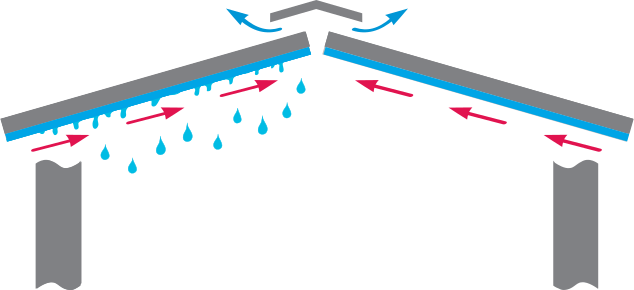
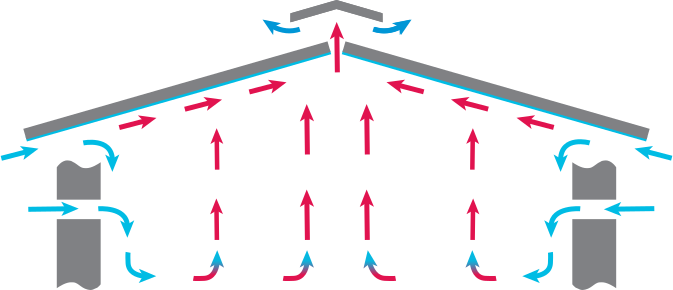
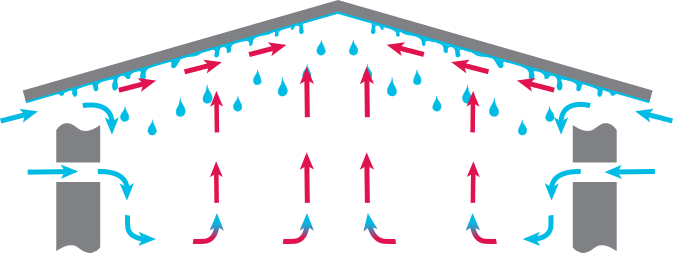
– Allowing humidity to rise in buildings when moisture is present.
– As it warms, it tends to rise.
– Droplets can rain down, causing damage to both the building and its contents.
Cheating the system
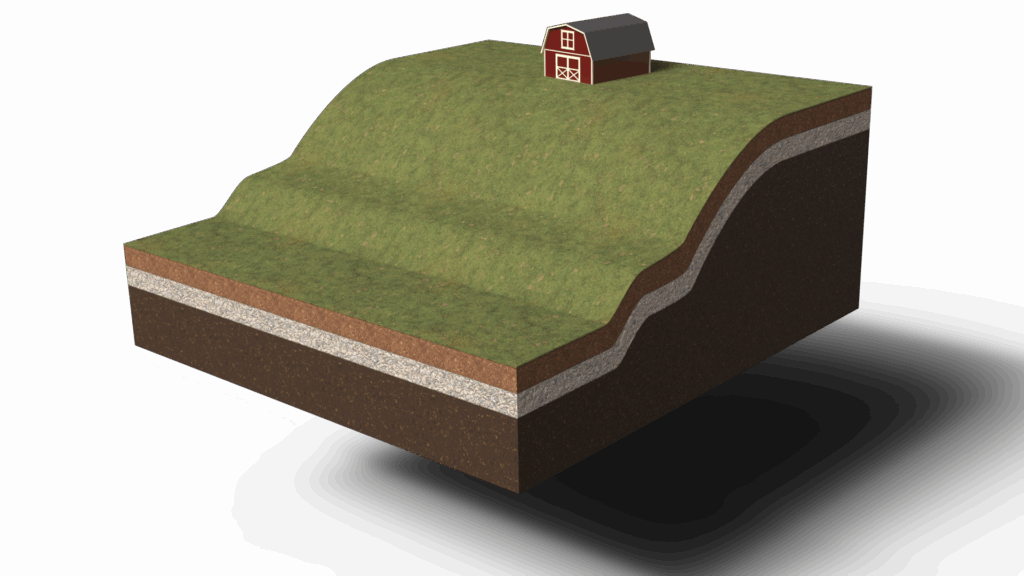
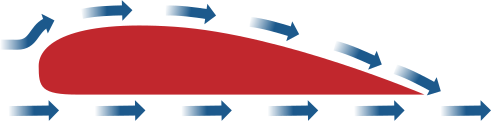
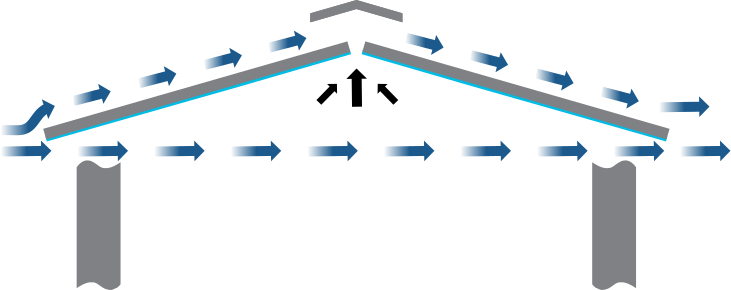
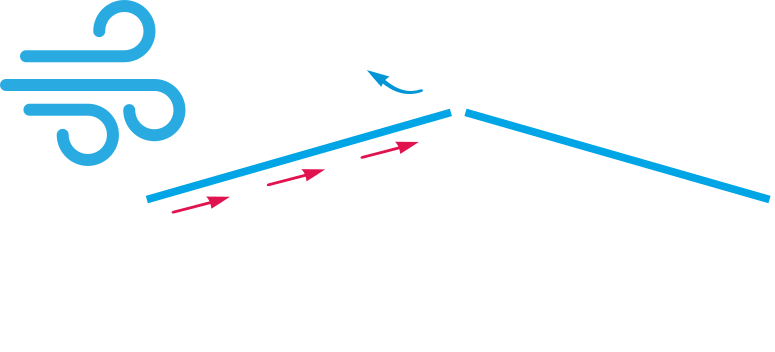
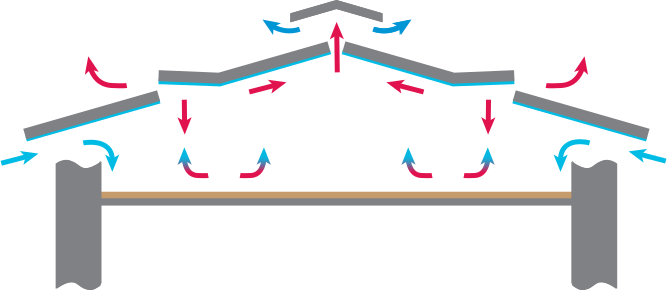
The difference in speed of wind blowing across, into and through a building causes areas of high and low pressure which creates lift. This lift is similar to a wing on an airplane, and is up to 9 times stronger than the effect of temperature differences.
A ventilation system is only as effective as it’s smallest part (inlet-outlet). If there is a difference, the inlet should be larger.
The greater the vertical difference between inlet and outlet the greater the chimney effect but there must be some difference for it to work at all. No horizontal chimneys.
The steeper the roof slope the better. Avoid roof slopes less than 3/12 or better 4/12
The wider the building, the less effective natural ventilation.
Correct
Correct
Incorrect
Insulation is used to help the inside to outside temperature difference at a specific humidity from reaching the dew point.
The vapor barrier is used to keep moisture from migrating through the insulation and reaching the cold building shell.
If you think you have a good grasp of this material, click the button below to take the Dripstop Pro Certification Test.
Agriculture
Barns
Livestock Housing
Open Deck Roofs
Equipment/Machinery Sheds
Storage & Utility
Self Storage
Workshops
Mechanical Buildings
Commodity Shelters
Garage & Carport
Car & Truck Ports
RV Storage
Airplane Hangers
Unattached Garages
One of our highest values is transparency, which is why we introduce you to the general terms of use of our website.
The general conditions describe, determine and regulate the use of the website’s content and services and represent a legally valid and binding agreement between the provider and the website’s users.
The website owner reserves the right to modify and/or delete any part of the website and/or any part of the content. By continuing to use the website, you agree to these terms and conditions.
Website Users
A user is any person who visits the website and uses it in any way. The use of the website is made available to an indefinite number of users who accept the service in the manner specified in these terms, under the conditions and in accordance with these terms.
Website Accessibility
As a rule, the website is accessible every day of the year and 24 hours a day. The website owner reserves the right to suspend access to the website for technical maintenance and equipment replacement reasons. The owner of the service does not guarantee the accessibility of the website in the event of possible outages in the providers’ networks, access routes or any other outages, errors, other technical disturbances or interruptions in the operation of third parties and in the event of force majeure.
Copyright
Content posted by the website owner is permitted to be reviewed and use is permitted in accordance with these General Terms and Conditions. The content may not be reproduced, modified, copied, republished and/or distributed for commercial or non-commercial purposes without the prior written permission of the website owner.
In the event of any permitted use of the contents of this website, all copyright marks of industrial property, as well as other notices and warnings, must remain preserved and visible. The user is allowed to make a link to the website in the case of quoting the contents of services or products. Links to this site may not be posted on sites with illegal or immoral content. At the request of this website owner, the owner of the website or product or service where the link is published is obliged to remove it.
The owner of this website is not responsible for the possible further disposal of the contents of the website by third parties, nor does it have any influence on the conduct of third parties, which the user is aware of and agrees with. The user also expressly guarantees that by publishing his content on the website, he does not infringe the intellectual property rights, nor the personal rights of third parties.
Trademarks that appear on the website, services or other products are registered trademarks, their holders or licensees are the owners of the website, related companies or third parties. Any use of these trademarks without the appropriate prior written consent of the rights holder is expressly prohibited. Signs that are not registered as trademarks are protected under the rules of copyright law.
If the user sends material protected in accordance with the Law on Industrial Property, the Law on Intellectual Property, the Law on Copyright and Related Rights and other regulations concerning the field of property and rights regulation, the website owner is not responsible for copyright infringement. The user who submits material to the owner of this website agrees not to request monetary compensation or payment for its publication.
Social network functions
The Website may include social networking functionality and the ability to post on our official profiles. The website owner allows users to post links and recommendations to social networks as social network functionalities allow.
Privacy policy/personal data protection/GDPR
We are aware that the privacy and security of your personal data are extremely valuable, we are aware of our responsibility and we undertake to protect the personal data and privacy of our customers, potential customers, website visitors and all individuals who disclose personal data to us upon contact (hereinafter: “users”) are carefully protected and used exclusively for the purposes stated in our Privacy Policy.
The website owner processes users’ personal data in accordance with the General Data Protection Regulation (GDPR) and other relevant regulations. For all additional clarifications regarding the protection of personal data, you can also write to us at our general email address.
Online cookies
Information about the use of the website, which is collected automatically and which does not allow insight into personal data, is used by the owner of the website for the purpose of providing the service and improving the use of the website, as specified in more detail in the cookie notice.
The website owner undertakes to always carefully protect the user’s data and not to pass it on to third parties.
All complaints and reclamations related to these general conditions and the use of the website are handled by the owner of the website on the basis of Slovenian and European legislation. We accept any complaints and reclamations at our main email address.
In case of well-founded complaints, we undertake to eliminate them as quickly as possible within the time specified by law and inform the user about this.
Protection of personal data
Our company is aware of its responsibility in handling the personal data of our customers, potential subscribers, visitors to our website and all individuals who disclose their personal data when contacting us (hereinafter: users). We guarantee and undertake to use users’ personal data exclusively for the purposes stated in this document (Privacy and Personal Data Protection Policy).
In this Privacy and Personal Data Protection Policy (hereinafter: the Policy), we define the methods of collecting users’ personal data, the purposes for which we collect it, the security measures we use to protect it, the people with whom we share it, and your rights in relation to protection personal data. The protection and handling of users’ personal data is fully coordinated with the provisions of the General Regulation on the Protection of Personal Data (Regulation (EU) 2016/679, hereinafter: GDPR) and other legal regulations governing the field of personal data protection. Our activities comply with European legislation and the conventions of the Council of Europe (ETS No. 108, ETS No. 181, ETS No. 185, ETS No. 189) and with the legislation of the Republic of Slovenia (Act on the Protection of Personal Data (ZVOP-1, Ur. Year of the Republic of Slovenia, No. 94/07) and the Act on Electronic Business on the Market (ZEPT, Year of the Republic of the Republic of Slovenia, No. 96/09 and 19/15)).
Personal data is any data on the characteristics, state, behavior or relationship that refers to a specific or identifiable natural person, i.e. an individual, depending on the form in which it is expressed. An identifiable natural person is one who can be directly or indirectly identified with the help of his identification numbers (e.g. EMŠO, tax number, health insurance number, telephone number, vehicle registration number), or by referring to factors that are characteristic of its physical, physiological, mental, economic, cultural or social identity (e.g. employment, title, function, position or status in a certain entity, etc.).
The website owner collects the following personal data in accordance with the purposes defined below in this privacy policy:
Processing of personal data means any operation or series of operations in relation to personal data that are processed automatically, or that are part of the collection of personal data during manual processing or are intended to be included in the collection of personal data, in particular collection, acquisition, entry, editing, storage, adapting or modifying, retrieving, viewing, using, disclosing by transmission, communicating, disseminating or otherwise making available, classifying or linking, blocking, anonymizing, deleting or destroying; processing can be manual or automated.
The website owner collects and processes users’ personal data on the following legal bases:
The owner of the website does not collect or process personal data of users, except when the user allows it or you agree to:
2.1. Processing of personal data based on consent
In our company, we collect and process personal data of users for the following purposes:
2.2. Processing based on laws and contractual agreements
In the event that the provision of personal data is a contractual obligation, an obligation necessary for the conclusion and implementation of a contract with the provider, or a legal obligation, we will have to ask you to provide your personal data; if you do not provide personal data, you will not be able to conclude a contract with the provider, nor will the provider be able to provide you with services or deliver products under the contract.
Our company is also a controller of personal data. We process data in accordance with the General Regulation on the Protection of Personal Data.
The authorized person for the protection of personal data in our company can be reached via the umbrella email address.
Our company does not forward the collected personal data of users to third parties or to third countries.
We keep the personal data that you entrusted to us with your personal and explicit consent when registering, signing up for e-newsletters, downloading e-publications or submitting an inquiry until you cancel it.
You can revoke your consent to the collection and processing of personal data at any time. Withdrawal of consent does not affect the lawfulness of data collection and processing prior to withdrawal. We store all other personal data within the framework of contractual cooperation in accordance with applicable legislation.
We take care of the protection of personal data in many ways. We store personal data in digital form, our computer systems are protected by technical and organizational measures that prevent accidental or illegal destruction, loss, alteration and unauthorized disclosure or access to your personal data.
We store the data we collect on secure servers until you cancel, but not longer than the maximum retention period. Business premises, equipment and system software, including input-output units, are also adequately protected.
The personal data of an individual, which is obtained on the basis of consent, can be processed and stored as long as there is a purpose or until the consent given by the individual is revoked.
The personal data of an individual processed on the basis of a contract may be processed and stored for another 5 years from the fulfillment of the contractual obligations of both parties.
In accordance with the law governing the area of value added tax, we keep invoices for 10 years after the end of the year to which the invoice refers.
We can process an individual’s personal data for our own needs until the consent is revoked by requesting the removal of personal data from the database, otherwise only for as long as is necessary to achieve the purpose for which the data was collected, i.e. 10 years for registered users and 5 years from the fulfillment of the contractual obligations of both parties or for all other users and until the subscriber unsubscribes from the e-newsletter or until the operator ceases its activity on the market.
During the management of personal data, the individual has the opportunity to view and update data in the database upon request. In accordance with the Value Added Tax Act, the company keeps invoices for 10 years after the year of issue of the invoice.
In accordance with the applicable legislation, the individual has the right to revoke the given consent at any time, to request inspection, correction, restriction of processing or deletion of personal data.
You can revoke your consent to the processing of personal data at any time. For this purpose, you can send us your request at any time to our email address or by regular mail to the company headquarters.
Individuals can also submit a complaint regarding the processing of their personal data to our address.
An individual can also submit a complaint regarding the processing of his personal data directly to the competent supervisory authority, i.e. To the Information Commissioner of the Republic of Slovenia.
In case of personal data protection violations, our company will immediately implement all internal and external measures (technical, organizational) to protect the rights and interests of the individual. Each of those affected will be notified of possible violations, as well as the competent supervisory authority in the Republic of Slovenia.
Policy
Cookies on our website
Our website uses cookies to improve the user experience. Cookies are small text files that are stored on your computer or other device when you visit a website and help to provide a better user experience. Cookies are stored in the file directory of the web browser. The next time you visit the website, the browser reads the cookie and transmits the information to the website or other element that set the cookie.
Cookies do not collect information. They are only helpful and enable a better user experience in cooperation between the server and the browser. Cookies ensure that you do not have to fill out all the forms when you visit the website again. They help show you the pages you need, show the most recently viewed ads, and more.
We distinguish two types of cookies:
Temporary cookies are created only temporarily, as long as the browser window is open, and record data during your browsing. These cookies are then deleted. Persistent cookies are stored and remain on your computer or other device. They are activated every time you visit the website again, unless you delete them in between.
Why do we use cookies?
We use cookies in order to offer you the best possible experience while visiting our website and to improve the website. We use the following cookies:
cookies with which we count the number of visitors to the page, cookies with which we investigate the movements of visitors on the page, cookies necessary for the operation of websites.
WE USE THE FOLLOWING COOKIES ON OUR WEBSITE
More about the use of cookies and when or in which cases they can be used can be found in the guidelines on the website of the Information Commissioner of the Republic of Slovenia.
Control and management of cookies
The user decides to use cookies himself. Cookies are under the complete control of the user and he can always limit or delete them or remove them and thus remove his visibility online. Also, most browsers can be set not to store cookies.
However, some cookies are necessary for the website to function properly. You can find information about cookie settings in individual browsers at the following links: Chrome, Firefox, Internet Explorer, Safari, Opera, Microsoft Edge.